

This website uses cookies so that we can provide you with the best user experience possible. Cookie information is stored in your browser and performs functions such as recognising you when you return to our website and helping our team to understand which sections of the website you find most interesting and useful.
05.02.2026
EU Committee of the Regions: where communities have a voice
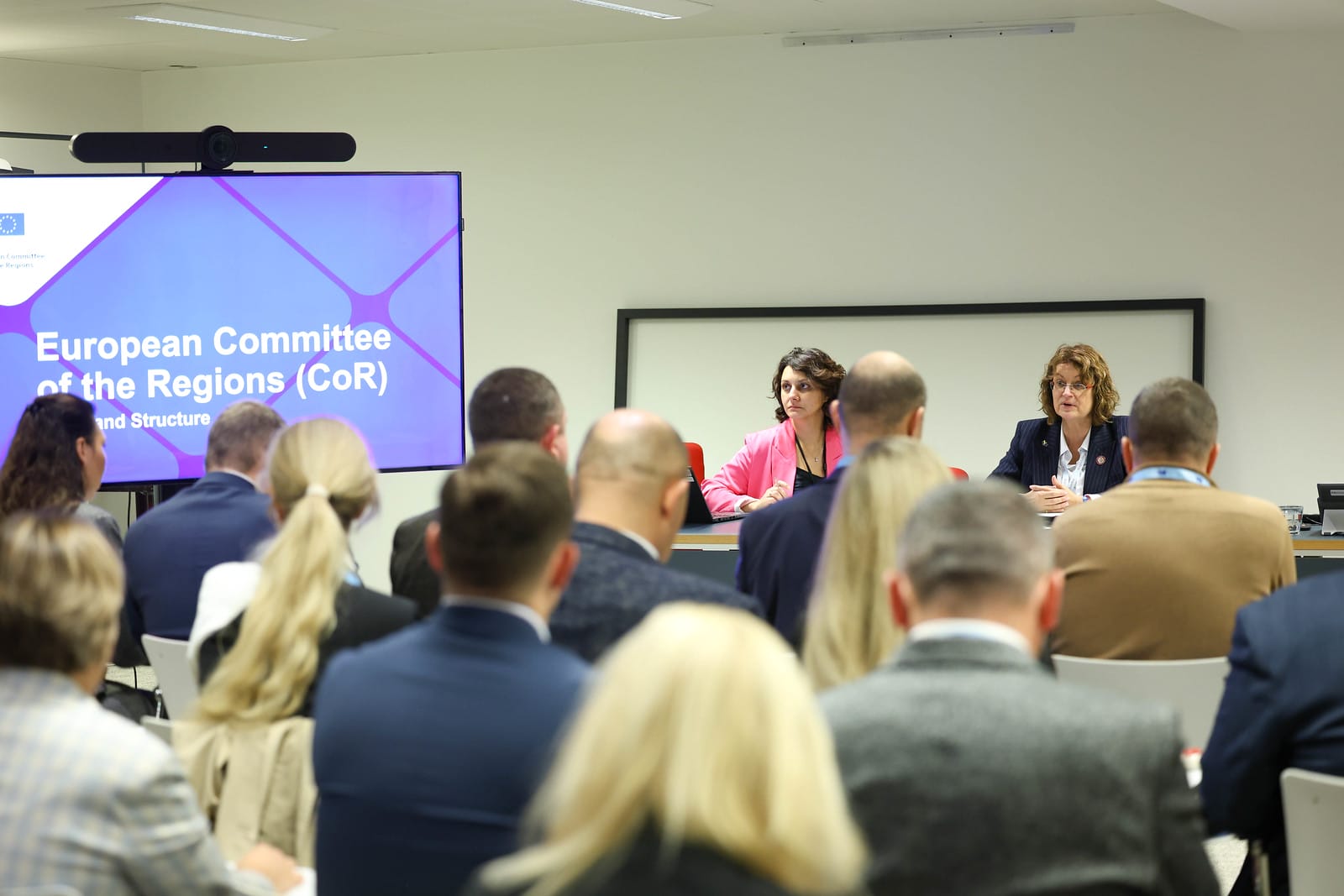
The Committee of the Regions of the European Union is an institution through which cities and regions influence EU decisions. For Ukrainian communities, cooperation with the EU means the opportunity to influence EU decisions on Ukraine in the process of European integration, which is beneficial for local self-government, developing cooperation with communities and regions in other European countries and understanding how European legislation is implemented at the local level.
The role of the Committee of the Regions in the EU, support for Ukraine during the war, and opportunities for cooperation were discussed with its representative at ‘Friday with Cities4Cities’ within the Polaris Programme “Supporting Multilevel Governance in Ukraine”. The guest of the meeting was Natalia Dolya, coordinator for relations with Ukraine and Moldova of the Commission on Citizenship Issues, Governance, Institutional and External Affairs (CIVEX).
From unilateral support to equal partnership
After the outbreak of full-scale war, Ukraine’s cooperation with the EU Committee of the Regions intensified.
One of the key formats for such cooperation is the Working Group of the Committee of the Regions on Ukraine, established to coordinate the Committee’s efforts to support local self-government in Ukraine during the war.
“Although the Group consists only of representatives of the Committee of the Regions, it is not just an internal discussion platform. We regularly invite Ukrainian mayors, local government associations, representatives of the European Commission, and experts. It is important for us to speak not in general terms, but about the real needs of communities and regions in Ukraine.”
As a result, during its work, the Working Group managed to advocate for issues important to Ukrainian local self-government, such as community access to funds from the Ukraine Facility and directing more resources towards reconstruction at the local level. In particular, during the Conference in Rome on the Reconstruction of Ukraine, the EU4Reconstruction programme with funding of €37 billion was announced.
The tenth meeting of the Working Group, held on 28 November in Prešov, was devoted to further decentralisation reform in Ukraine and preparations for the Ukraine Reconstruction Conference (URC), which will take place in Poland in 2026. In this context, it is important to strengthen the role of communities in the reconstruction of Ukraine.
At the same time, work continues on the creation of a Joint Consultative Committee between Ukraine and the EU (Joint Consultative Committee) — a formalised body for political dialogue between local and regional authorities in Ukraine and the EU.
“We are talking about a body with equal representation: the same number of members from the Committee of the Regions and from Ukraine. Ukraine will determine its own representatives, but a democratic mandate, current position, political pluralism and gender balance will be important. This will be a much stronger format for interaction.”
European Alliance of Cities and Regions for the Reconstruction of Ukraine: how to join and what it offers
One of the key practical platforms for supporting communities in Ukraine is the European Alliance of Cities and Regions for the Reconstruction of Ukraine. The Committee of the Regions acts as the secretariat, while the Alliance itself is an open network.
Today, it has about 85 members — cities, regions, and donor organisations from different EU countries and Ukraine. The Alliance holds monthly online meetings to discuss important topics in the context of reconstruction and European Ukraine at the local level and present relevant opportunities for Ukrainian communities and coordinate efforts to achieve maximum synergies in supporting Ukraine. Ukrainian communities can also become members of the Alliance.
“It is not a closed club or a membership-based organisation. But it is important that participants are ready to participate, share their experiences, and raise their questions. The Alliance is only as active as its members are.”
How can communities join the Alliance?
Formally — send a letter of appeal to the secretariat of the Committee of the Regions. In practice, however, political interest is key: a willingness to participate in meetings, present one’s needs, and seek partners.
“What is decisive is not the formal procedure, but the clearly articulated interest of the community. In your application to the Alliance, it is important to briefly explain who you represent. (Note: Regional development agencies may also participate), why participation in this platform is relevant for them and what areas of cooperation are priorities — from reconstruction to municipal partnerships.”
Programmes and initiatives: where the Committee of the Regions is a partner and advocate
Natalia Dolya emphasises separately: the Committee of the Regions is not a donor and does not finance projects directly. Its role is to provide political support, advocate for communities’ interests, and create conditions that make other EU instruments more accessible.
It was precisely this logic that shaped the 10-point Support Package for Ukraine. This is not a fixed list, but a document that is updated depending on the situation.
“We are constantly reviewing this package, adding new elements, seeing what works and what needs to be corrected. This is a living frame of our support for Ukraine.”
Among the programmes and initiatives in which the Committee of the Regions plays an active role:
Tips4UA
An internship programme for Ukrainian communities and regions in the EU, helping Ukrainian communities to better navigate European policies, opportunities and partnership formats. The programme was launched last year and has demonstrated excellent results. We are currently recruiting European partners who will be ready to host Ukrainian colleagues next year. The competition for Ukrainian communities will be announced early next year.
European Partnership Hub – Bridges of Trust (a new phase)
The hub was a logical continuation of the Alliance’s policy recommendations following the Rome Conference on Ukraine’s Reconstruction. Its goal is to make municipal partnerships not isolated but systematic, and to make the search for partners in Ukraine as simple and straightforward as possible.
Young Elected Politicians
A network for local and regional politicians under the age of 35. It provides an opportunity to participate in events in Brussels, learn about the work of European institutions and develop international contacts. Since the programme opened for Ukraine in 2023, 11 Ukrainians have already become participants.
“This is a long-term investment. The people who are young local politicians today will be making key decisions tomorrow. Perhaps these are future members of the Committee of the Regions from Ukraine.”
Pavlo Adamovych Award
A flagship initiative of the Committee of the Regions, which honours the memory of the mayor of Gdańsk, who was killed for his pro-European and democratic position. The award honours mayors who defend human rights, democracy and dignity, particularly in difficult and dangerous circumstances. Several Ukrainian mayors were nominated and even awarded this prize during the war.
Analytics and access to the Ukraine Facility
The Committee of the Regions also prepares analytical materials on local and regional participation in Ukraine’s reconstruction and European integration processes.
Among the noteworthy materials on Ukrainian municipalities is a study devoted to Ukrainian communities’ access to capacity-building tools within the framework of the Ukraine Facility.
In addition, a separate brochure entitled “Funding opportunities and capacity building programmes for Ukrainian LRAs” summarises the available funding and training programmes.
“It was important for us not just to list the opportunities, but to see whether local and regional authorities really have access to them, including the 20% of the Ukrainian plan that is declared for this level.”
Committee of the Regions: institutional framework
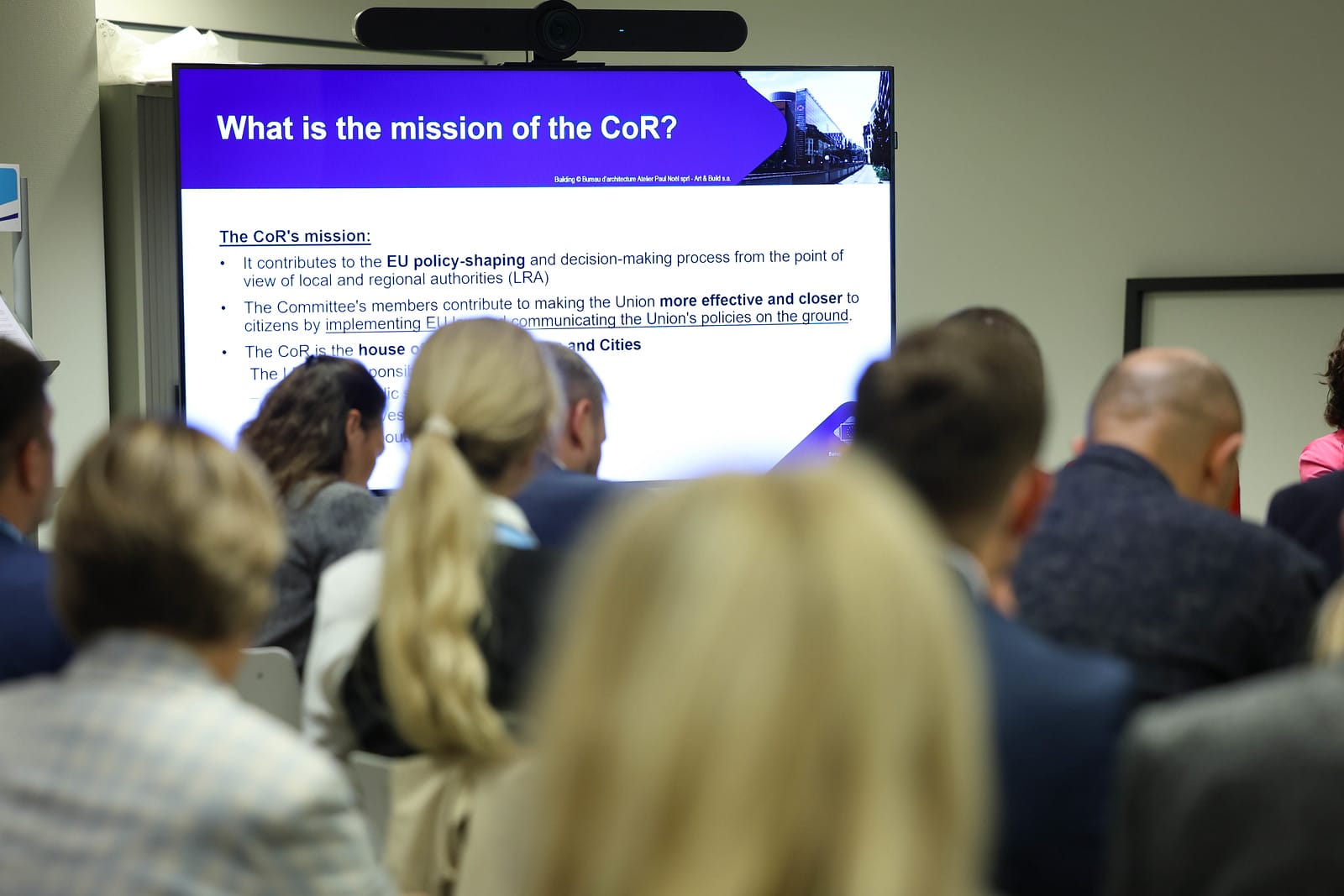
The EU Committee of the Regions was established in 1994 as a political institution representing local and regional authorities. It consists of 329 elected politicians nominated by member states.
The Committee’s activities are based on the principle of subsidiarity, according to which political decisions are taken at the level closest to the citizens.
“About 70% of European Union legislation is implemented precisely at the local level. Therefore, without capable communities, European integration simply does not work.”
That is why local authority representatives should start working with the Committee of the Regions now to prepare to defend their interests in the EU after Ukraine’s accession.
The Cities4Cities initiative implements the “International Municipal Cooperation” sphere of the Swedish-Ukrainian Polaris Programme “Supporting MultiLevel Governance in Ukraine“, which is funded by Sida and implemented by SALAR International.